
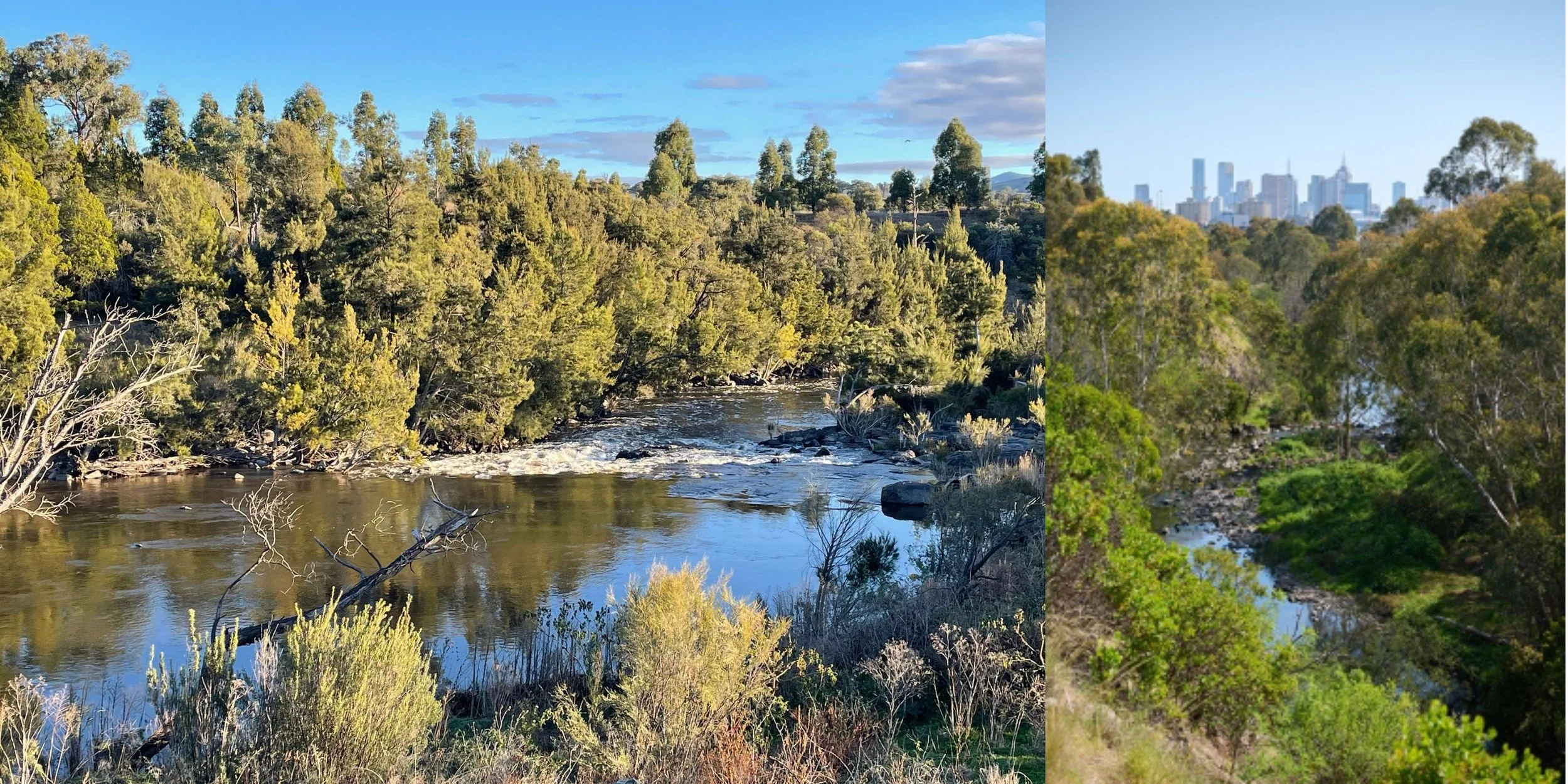
Left image: The Murrumbidgee River at Pine Island in the ACT, May 2024. Photo: uncredited.
Right image: Merri Merri Creek near its confluence with Birruarung. Source: Victorian Department of Transport and Planning
Please join us to explore the national theme of this year’s Festival – Translocality through being part of a conversation on:
Planning in the Nation’s Capital and Region and how might it be shaped by River Rights – it this a Fantasy or Reality!
Translocality is founded on interconnectedness between different places and people, beyond national boundaries. The circulation of people, goods, knowledge and capital, though an ancient process, is facilitated and impacted by new technologies. These bring new opportunities and challenges for cities and regions.
The Festival Urbanism 2026 Canberra event is shining a light on cultural and environmental dimensions of translocalism and its implications for planning in the Nation’s Capital and its region. Planning is fundamental to protecting our environment and having a voice for the environment while complex has never been more critical than at this moment in time.
Come and hear how the iconic Birrarung (AKA Yarra River) has a voice which has resulted in it having a legal status that has changed how the river is now treated in planning decisions. This raises questions for rivers in the nation’s capital and its region - importantly would the nation and region’s major rivers especially the Upper Murrumbidgee River, be healthier if they had a legal status as a living entity, as does Birrarung?
Free event and for catering purposes please RSVP by 19 October 2026
The Canberra event is supported by the Henry Halloran Urban and Regional Research Initiative at the University of Sydney, with assistance from the School of Architecture, Design and Planning, Planning Institute of Australia, University of Canberra and Upper Murrumbidgee Catchment Network.
We will hear from
Professor Fiona Dyer, UC, will share her insights as a long-time leading researcher and advocate for healthy rivers in the Nation’s Capital and Region.
Kinjia Munkara-Murray, Birrarung Council will speak about A Journey from Recognition to Action to sharethe story of how Birrarung became one of the first rivers in Australia to be legally recognised as a Living Entity. She will discuss the role of Birrarung Council as an independent statutory ‘Voice’ for the river, amplifying Traditional Custodian leadership and advocating for the River's interests. The session will explore how governance, partnerships and accountability mechanisms turn this recognition into tangible action for Birrarung's future.
Claire Romaszko, Planning and Land Services, Department of Transport and Planning Victoria will share what it means for Planning by Birrarung being legally recognised. She will discuss how Victoria is strengthening planning protections for waterways while advancing recognition of Birrarung (Yarra River) as a living entity. Claire will reflect on the opportunities, challenges and partnerships involved in translating ambitious policy into practical planning outcomes.
Antia Brademan, Executive member Upper Murrumbidgee Catchment Network (UMCN) will prespond to the presentations and discuss the importance of connections and outline how the recently released Walking together for Country guide may assist in forging legal recognition of our local regional rivers, specifically the upper Murrumbidgee River.
Paul Knight, is a Dharawal and Yuin man, will respond to the presentations and provide insights he has gained from working across the local region with various cultural groups in helping shape policies and communication documents such as the regional Walking together for Country guide.
Acknolwedgement
All Traditional Custodians of the ACT and surrounding region are recognised, as are other people or families with connection to the upper Murrumbidgee River catchment. Traditional Custodians have cared for and managed the lands and waters of this Country for tens of thousands of years. We respect their deep cultural, spiritual and practical knowledge, and the continuous connections that are the foundation of their Caring for Country practices – practices that recognise the reciprocal relationships between people, land, water, and all living beings that provide cultural stewardship which are fundamental to having healthy catchments and communities.